 Dec 10, 2025
 3 min read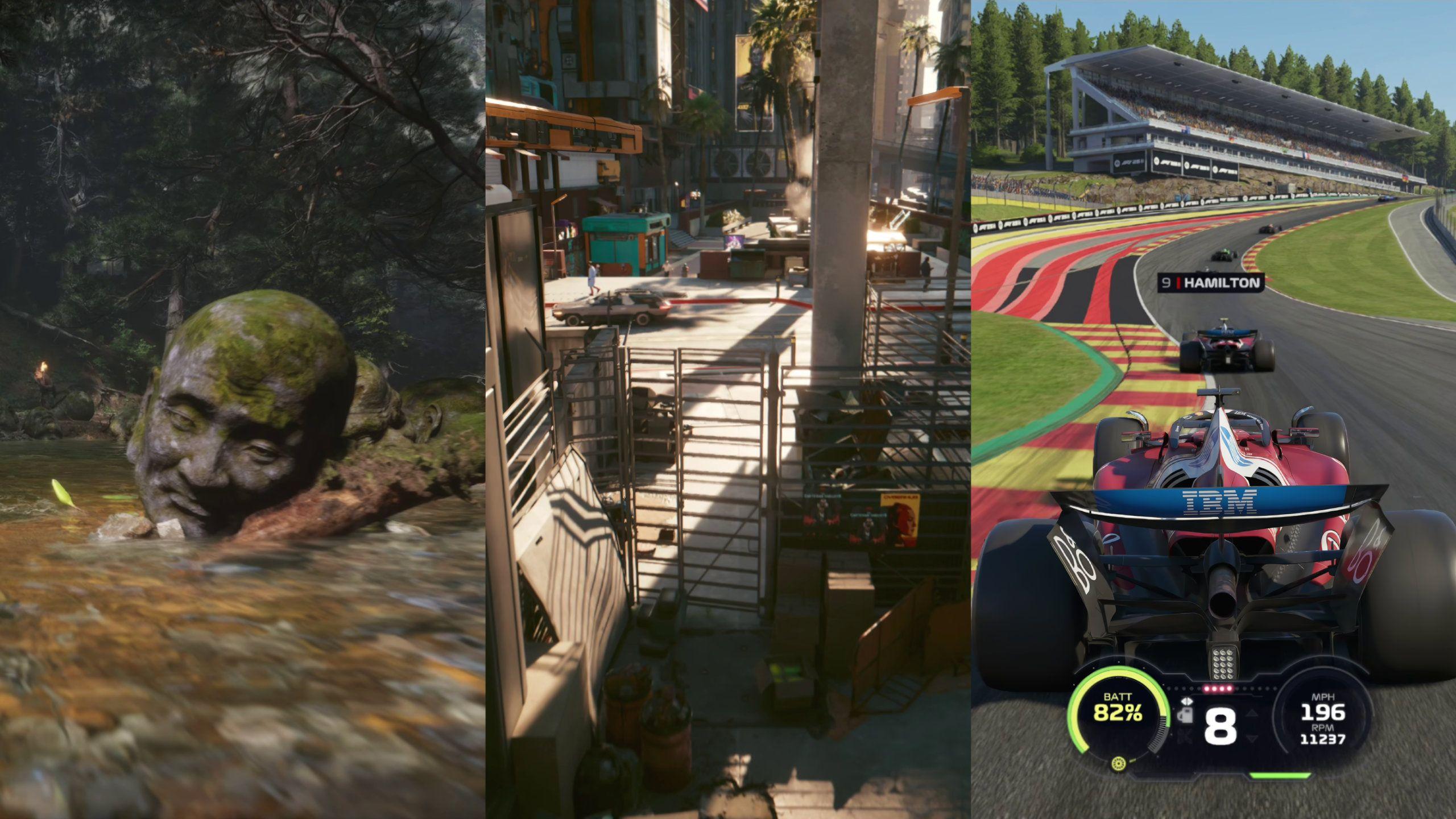
It's not actually FSR Redstone.It's all FSR now for reasons that only make sense to AMD.
FSR Redstone test: AMD's long-awaited generation of AI-powered frames delivers good, but is very late to market
Of course, it is not redstone.All of that just happened because it was just the reason for the reason to feel so much.
It's been nearly seven months since it was first announced, but AMD's much-vaunted machine learning-powered FSR update is finally here. With today's AMD Adrenalin 25.12.1 driver release, you too can jump into the new FSR. As long as you have an RDNA 4 card. Better known as FSR "Redstone," the work done here essentially puts AMD on par with Nvidia and Intel in applying AI to scaling, frame generation, and other techniques.rendering.
Now, though, it's worth noting that AMD doesn't have a multi-frame generation yet, so it's not quite at the same level yet. It's too early to tell if the new FSR frame generation is as good as DLSS MFG or XeSS-MFG in terms of image quality, since it's only available for a relatively small number of games.
Something else I need to get out of the way is AMD's strange decision to drop any number with FSR.For example, FSR 4 was announced in February and brought AI-powered upscaling to games on RDNA 4 graphics cards.
It is now simply called AMD FSR Upscaling.But it's also the same name for the upscaler of FSR 3. And FSR 2. However, they don't use machine learning.To differentiate them all, AMD's more detailed terminologies are AMD FSR Upscaling (Analytical) and AMD FSR Upscaling (ML).
The same applies to FSR Framework Generation 3: now called AMD FSR Framework Generation (Analysis), with the new version in Redstone having the same label as ML in brackets.I'll come back to this later because it bothers me (just a touch? -Ed).
Production of photo frames
FSR Redstone represents three items, although one has already been released (FSR Ray Regeneration), and of the remaining two, FSR Frame Generation and FSR Radiance Cache, the latter is not available for preview and won't appear in games until next year anyway.So this means that my entire FSR Redstone testing consists of a new framework gene system.
Good job, then the money is just right.For the same reason, FSR 4's upscaling is much better than FSR 3. By using AI to calculate the colors for the generated frames, you can say goodbye to almost all of the strange artifacts that occur with the FSR 3 frame generation.
Stay up to date with the biggest stories and best deals curated by the PC Gamer team.
As I already mentioned, FSR Generation (ML One) only works in a few games at this time -11 with certainty.I picked some of them for you to see first, testing them using FSR 3 and the Gens series and then again, but in full action with Redstone.
The test PC consisted of a Ryzen 9 9900X MSI MEG X870 Godlike with 32GB DDR5-6000 CL32 and an Asus Prime Radeon RX 9070 XT.I used the built-in benchmarks for some games so you can directly compare images/performance with your system.
For a game using resstone (I.E. in FSR 4 and FRAME FRAME and FRAME FRAME to use the same players.
Until developers apply directly to redstone (FSR, if you want AMD's name for everything now), this is the only way to do it.Some games automatically change the name for FSR 3 / 3.1 Update to FSR 4 (for example Cyberpunk 2077), but it may be a good time before a good fix is applied to the games.
Dark Legend: Wukong
I ran A Dark Legend: Wukong in 4K, using the Cinematic graphics set, but without full ray tracing enabled.For both abductors, the efficiency improvement (i.e. 50%) was used, and the generation of frames.I completely forgot to move the darn pointer out of the way, both times, and we saw it too late.A mistake, I'm sorry for that...
Of course, seeing only half of the frame isn't the best way to judge everything, but there's enough exposure to see that the FSR Redstone is noticeably better than the FSR 3.Most of the quality improvements are due to FSR 4 (sorry, FSR Upscaling (ML), which preserves almost all of the native texture detail and doesn't leave out things like linear interpolation.
The little man is so good at this game that it's difficult to see where the new model performs well, even in the full video.See it more in-game, when you quickly identify surrounding cameras: with FSR 3 Conflict 'does not draw things that are viewed, but not in the AI system.
Best of all, there is no performance difference when using the Redstone frame gene compared to FSR 3. There is a performance hit for using FSR 4 (for simplicity I'll just call it FSR Upscaling (ML) instead of the new name), but it's pretty minor all things considered.
It's a similar story with cyberpunk 2077, remastered in 4K using the RT Ultra graphics preset.Redstone has a bigger performance than black legend: Wukong, but again, it's not big enough to worry about, and that's done by the upscaler, not the frame generator.
It's a little hard to see in the video above, but AMD's machine learning systems capture the details of dust, fog, and smoke better than the standard FSR 3. But just like Wukong, the older technology is well implemented in the game, so the fixes were mostly minor.
The Redstone framework favors camera changes and thin materials feeding materials such as power lines.I tried to capture everything but they disappeared in the video compression.
If there's one game that desperately needs AIS, it's F1 25. Just watch the first 30 or 4 seconds of the video above to see what I mean.FSR 3 Frame Gen Besters really cast a shadow on racing, especially players
Not so with redstone.It generates them almost perfectly, although not always, and you can still see some glitches with the car in the distance.However, some of them still have no frames generated, so this may be caused by the engine using low-resolution shadows when the car is far away from the camera.
Again, this is all achieved with only a very small performance gain compared to FSR 3. Without using upscaling, at 4K Ultra High, the F1 25 runs at about 40fps, a 1% drop to 29fps. If you have an RDNA 4 card, go to the Adrenaline software, hit toggles, and start playing again.Once in, enable FSR 3 upgrade and FrameGen and the software will ignore all of that and use the good stuff.
Grand Got Auto 5: Upgrade
For a quick test of the FSR Redstone frame generator, I chose GTA 5: Rising from a list of 31 games.Minor correction: I first selected Mafia: Old Country, but the game settings menu was just blank no matter what I tried.
GTA 5 testing is difficult at the best of times because when you restart the entire game (which you have to do to activate Redstone), you don't start where you last saved.Please forgive the videos above for not syncing and just try to focus on how well FSR 3's AI stuff works.
I think it's fair to say that there isn't much of a difference in terms of visual quality. Redstone does a slightly better job of keeping the cores fast and blocking, and if they pass quickly, it's not a handled comparison.
Tested again at 4K resolution with pre-mentioned game high, GTA 5 showed a 30 FPS over the lower setting of 1%.The Ray tracing in this game can be brutal on the GPU, especially when all the races are over the RDNA 4 card when it has to juggle a lot of scaling and A.I.
Call of Duty: Black Ops 7
Call of Duty: Black Ops 7 is one of the few games that likes to switch to AI frame generation, so I turned my attention to something else from Redstone: FSR Ray Regeneration.This is AMD's answer to Nvidia's DLSS beam regeneration and does a better job at reconstructing and recreating images of reflective surfaces.
Black Ops: 7 is the only game currently supported, and I have to say it's a strange choice to showcase the technology.I mean, who would take the time to check the accuracy of reflections on a shiny floor in the middle of a raging battle?
Anyway, the video above is a "simple" comparison between Redstone (i.e. what FSR 4 + AI frames have) and Redstone with ray reconstruction enabled.If you look closely, you can certainly see where the AI denoiser is actually improving.Interestingly, you can also see that the problem occurs where the frame is, although not as easily.
In a few frames between 19 and 20 seconds of the video, flat running on redstone produces strange-looking steps coming out of the pool. It cannot be detected during actual gameplay, as it can only be detected by moving a few frames at a time. This shows that, like other frame generators, Redstone, while good, is not perfect.
FSR Ray regeneration may not have a much impact on Black OPS 7, or at least on the benchmarks of the game.
The missing piece: the FSR Radiance cache
The last part of the FSR Redstone to discuss is a bit awkward.That's because it's not something that PC gamers will ever be able to use directly themselves, as it's meant to be used by developers within the engine.The same is true of any part of FSR (you can't magically make it work in a game that doesn't have it implemented), but these still have some degree of user interaction.
Amos Josh Hot, Consumer Guide Using Products We Can Do
"By running FSR RADICACE CALDICATE PASING FINECTATE through a second radiation stage, using fewer radiations and less violence, I deliver faster, less violence to high-quality staff."
In this phase, "we" is not very clean, "we" is the training phase: is the training phase completely done by AMD or is it done by the developer?The updated SDK of FSR should be available on GPUOPEN during the lifetime of this article, so I hope to be able to check it out.
AMD revealed a short version of the Warhammy 40,000: Dark Radiance Cache
My problems with FSR Redstone
Let's be clear about one thing: Whatever you want to call it, FSR Redstone is a success.AI upscaler is very good.The AI frame generator is probably even better.One use case sample for AI Denoiser isn't enough to decide if it's something you want to enable all the time, but it does look good.
But that doesn't mean AMD is taking off.For starters, it's too late, too late to market.Nvidia introduced AI-based frameworks in September 2022, and Intel followed suit in December 2024, with updates since then.
Since, AmD's Rdna 4 GPUS have been around this year, and while they have FSR 4 quickly, it shouldn't take that much to get out of the FSR gate.Why did FSR Ray Ratnation have a major release in anger.I suspect that amd originally planned for the FSR 4 to be a complete packadtone, but the development and delays have pushed it further and further back.
It's my other Greek with FSR Redsone.Full names in games, FDCC.
The number is important because when they are inevitably updated, how are gamers and developers supposed to differentiate the versions?There will be version codes that will be used by AMD's FSR developers, so why bury them under marketing fluff?
Finally, I'm not too happy that all of this has to be done via the Adrenaline software tool to use the new FSR's key features.This is already true in FSR 4, but now you have to do the same in the ML version of frame construction.I agree it's not a big deal, because if you have an RDNA 4 graphics card, you want to use Redstone all the time, you really want to use Redstone.
The engineers behind AMD's GPUs and software are true wizards, and both RDNA 4 and FSR are the real deal.It's a shame that the company can't or won't get better control over its marketing division.
1.
2. Best Value: AMD Radeon RX 9060 XT 16GB
3. Best Budget: Intel Arc B570
4. Jamari pangalusian: nvidia geforce rtx
5. Best high-end: Nvidia GeForce RTX 5090
Nick, games, and computers first met in the early 1980s.After graduating from university, I became a physics and IT teacher and started writing about technology in the late 1990s.As a result, he worked with MadOnion to create help files for 3DMark and PCMark.After a short stint at Beyond3D.com, Nick joined Futuremark (rebranded to MadOnion) full time and became Editor-in-Chief of the PC gaming section, YouGamers.After the site was shut down, he served as an engineering and computing lecturer for several years, but lost the writing bug.I've been with TechSpot.com for 4 years, covering all things tech and PC related.He freely admits that he's too obsessed with GPUs and the open world of RPGs, and who isn't now?
You must verify your public screen name before commenting
Please login and then Login, you will be asked to enter your username.